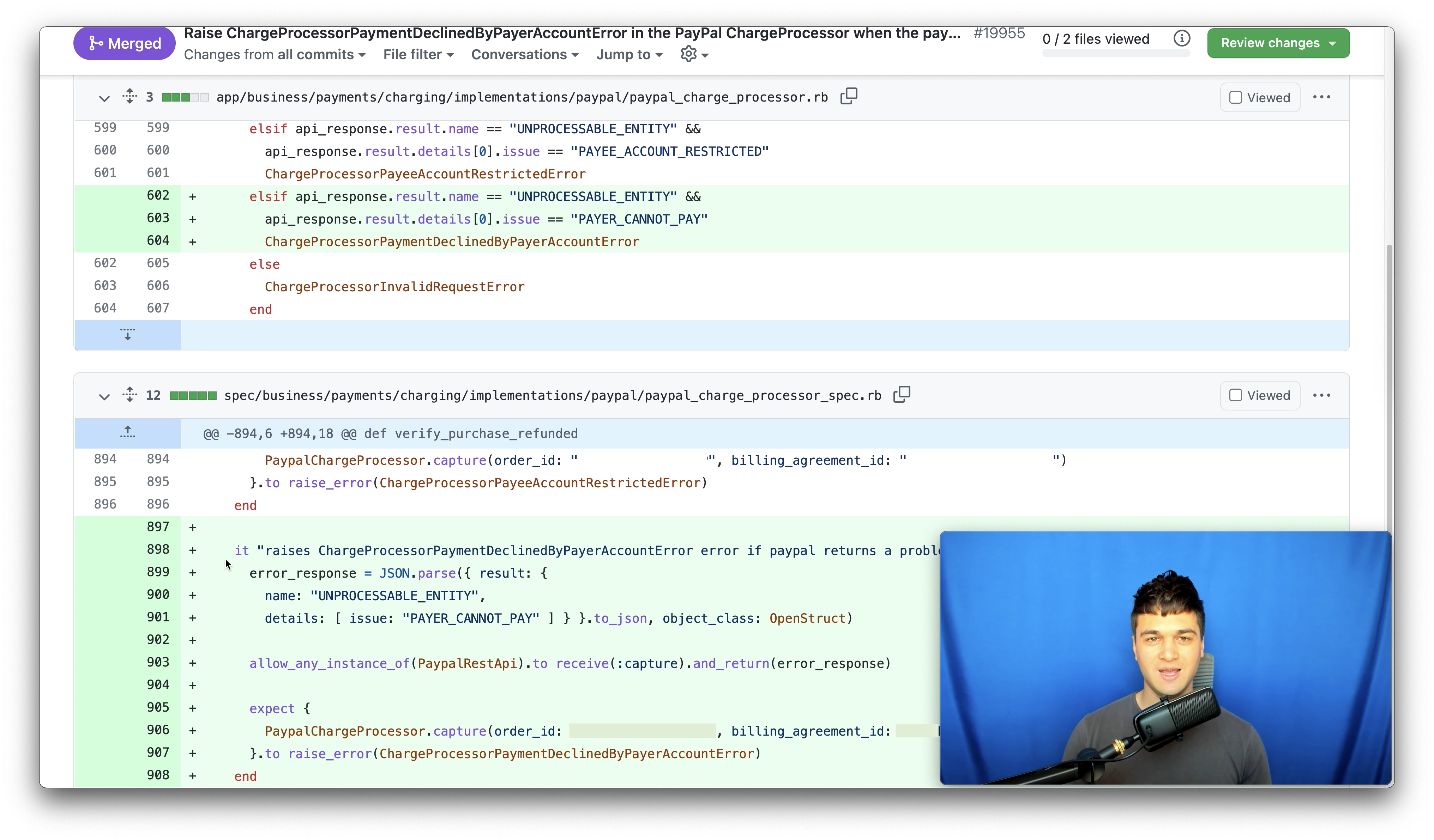
Most teams are doing code reviews wrong. Here are 3 warning signs, and 3 fixes.
Software engineer; solopreneur. Writing to help developers level up. Follow me on Twitter for more.
Software engineers engage in code reviews daily.
Some teams have a great code review process. Others could use improvement.
Here are 3 signs of a bad code review process, and how your team can ship faster.
3 signs of a bad code review process
🚩 If code reviews make you, or other developers, anxious.
Likely, reviewers aren't prioritizing kindness. Or they're on a power trip, gatekeeping over minutiae.
The result? Deteriorating relationships.
🚩 If it's common for one pull request to go through many review cycles — maybe even 7 or more.
Likely, reviewers are giving ambiguous feedback. Authors don't have a clear path forward, and go down rabbit holes between reviews.
The result? Discouragement, and wasted time.
🚩 If there's a lot of back and forth — if lengthy discussion threads are common.
Likely, the team isn't equipped to resolve disagreements. Or the team isn't aligned on nuanced readability principles.
The result? Delayed shipping.
 Photo by NeONBRAND on Unsplash
I've been on a variety of software engineering teams, in and outside of FAANG. I've seen the above come into play over and over again. It's a problem industry-wide.
One-off occurrences of the above are nothing to worry about. But if they're common, your code review process needs improvement.
It's easy to blame individual code reviewers. But to implement a solution that lasts, these problems should be solved at the level of the team or organization.
But where do we start?
First, understand that some aspects of code reviews are objective — finding flaws and defects.
But most aspects are subjective — opinionated discussions around software quality and readability.
Subjectivity drives inevitable disagreements. So we need to establish an environment that effectively handles these disagreements.
3 keys to a good code review process
Here are our goals:
- 1️⃣ Encourage healthy disagreements
- 2️⃣ Proactively prevent disagreements
- 3️⃣ Methodically resolve disagreements
But how?
It starts with documentation: team-level code review guidelines.
1️⃣ Encourage healthy disagreements
Document code reviewer expectations on how to give feedback.
When I was a software engineer at Amazon Web Services, guidelines for my teams included:
- Be kind
- Comment on the code, not the person
- Prefix nitpicks with "nit"
- Give a reason why, and a clear path forward
2️⃣ Proactively prevent disagreements
There are all kinds of readability principles out there. "Functions should be small" and "class names should be nouns."
Even the best programmers disagree on those, and other principles of readability. Chances are, your team will too.
So, document your team's stance on the nuanced principles.
For example, here's the Gumroad team's stance on the popular principle, "Don't Repeat Yourself." Credit goes to the Gumroad engineers for this one. 👇
"Repetition is better than the wrong abstraction.
There is nothing wrong with repetition. Approaching DRY (Don't Repeat Yourself) as a maxim will lead to code that is difficult to adapt to changes, and it will increase cognitive burden. Repetition can be consolidated more easily than the wrong abstraction can be untangled. Do repeat yourself until a clear pattern starts to emerge in a handful of different places. Think about whether their similarity is coincidental."
You may agree or disagree with that statement — that doesn't matter. The team came to a decision as a unit. This influences future contributors of the codebase, and prevents many subjective discussions on the topic.
3️⃣ Methodically resolve disagreements
Document how the team should drive disagreements to a resolution.
Verbal conversations work great. Establish a final decision maker to handle an impasse between two developers.
- Engineering discussion ➡️ Tech Lead
- Product discussion ➡️ Product Manager
- Design discussion ➡️ UX Designer
So, let's recap!
3 signs of a bad code review process:
- 🚩 Feeling anxious
- 🚩 Many review cycles
- 🚩 Back-and-forth
3 keys to a great code review process:
- 1️⃣ Encourage healthy disagreements
- 2️⃣ Proactively prevent disagreements
- 3️⃣ Methodically resolve disagreements
Empower your team to ship better software, faster. 💡
Like this article? It's an excerpt from my upcoming video course!
Master the Code Review
- 1️⃣ Write better code
- 2️⃣ Give better reviews
- 3️⃣ Forge a better process
Code reviews are critically important. But there's limited content on how developers can succeed in a code review environment. I'm looking to change that.
📬 Subscribe for a free lesson, and discounted pre-order announcements!
👉 https://curtiseinsmann.com/